Geoenergy Scientist & Consultant (geoengineering/mining) — Leipzig, DE

Piercarlo Giacomel, PhD

Geoenergy Scientist & Consultant

Bridging a decade of experimental rock mechanics with computational modelling and scientific software. De-risking carbon storage, geothermal power, and nuclear waste disposal, with gas and hydrogen storage as an emerging focus.

GeomechanicsFault mechanicsCCSGeothermalInduced seismicityRadioactive wasteGas storage (emerging)
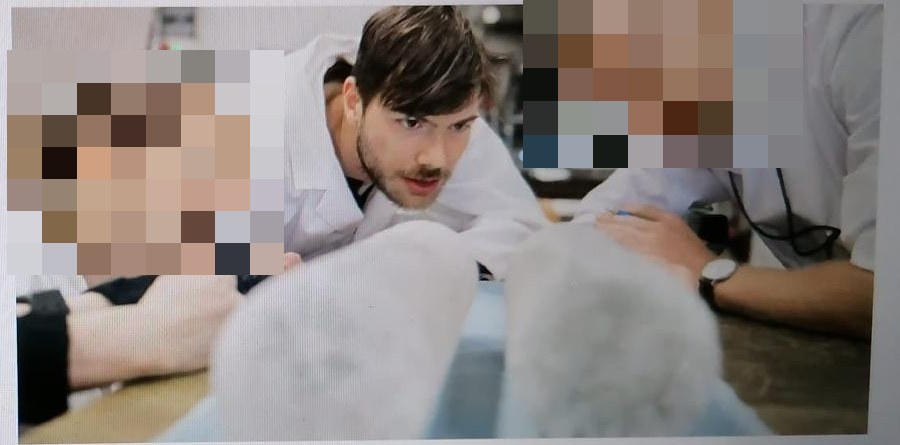
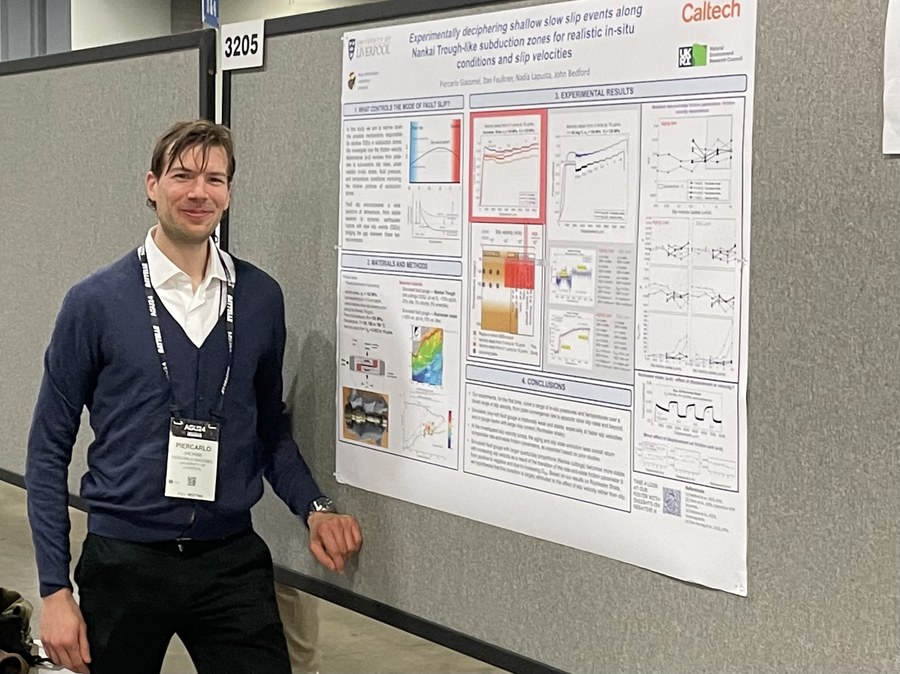
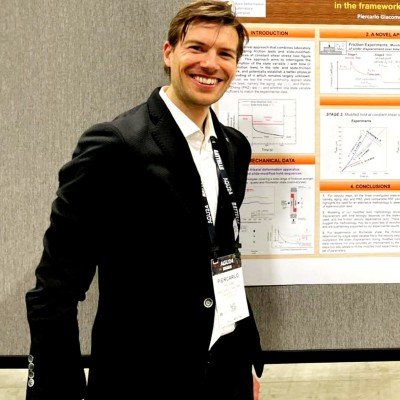
Piercarlo Giacomel at the AGU Fall Meeting poster session
AGU FALL MEETING 2024 · POSTER SESSION
Competence stratigraphy

Read the section, bottom-up.

Like a geological log: each capability was deposited on top of the previous one, nothing replaced, everything integrated. Select a layer to inspect it.

▲ youngest at the top, oldest at the bottom, as in any stratigraphic log

Career journey · core log

From the lab to the field scale, always in service of one goal: the energy transition.

One mission. Four countries. Ten years. From the laboratory to numerical models, from models to software — and next, to machine learning and AI applied to geoscience.

Mar 2025 — today

Research Scientist & Consultant — Geoenergy & Salt Geomechanics/Mining Engineering

Institut für Gebirgsmechanik (IfG) · Leipzig, Germany

  • 3D coupled thermo-hydro-mechanical modelling (FLAC3D, 3DEC) for the integrity and stability of salt caverns for brine production, room-and-pillar salt mining, and radioactive-waste barriers; subsidence prediction.
  • As of September 2026, Piercarlo had completed five client engagements and was contributing to two active client projects plus a separate IfG-CavernTherm CH₄/H₂ R&D workstream.
  • Completed the initial development of IfG-CavernTherm as a separate milestone, not as an additional client engagement.
  • Wellbore data interpretation: borehole sonar, gamma-ray, multi-arm caliper, resistivity and thermal profiles, including 3D reconstruction and volume calculation from sonar.
  • Geomechanical assessment of casing deformation and annulus closure induced by salt creep; work on a German salt-cavern field is to be presented at the 55. Geomechanik-Kolloquium.
  • Developed IfG-CavernTherm, a Python/Numba 2D axisymmetric finite-volume thermal solver feeding a sequential coupling with FLAC3D for overpressure prediction.

NOW READING → CH₄/H₂ storage · ML & AI for geoenergy · finite difference numerical modelling (Lagrangian and Eulerian methods) (loading…)
Feb 2022 — Feb 2025

Postdoctoral Researcher — Fault Mechanics

University of Liverpool, UK · collaboration with Caltech

  • At the University of Liverpool, Piercarlo served as a key experimental researcher on a £500k NERC-funded programme, with full operational responsibility for the experimental work.
  • As a Postdoctoral Researcher from February 2022 to February 2025, he conducted HP-HT friction experiments down to tectonic plate rates, informing shallow slow-slip events (Nankai) and seismic risk in geothermal systems; permeametry at HP-HT conditions and dilatancy measurements; SEM.
  • Released steadystate, a MATLAB package improving fault-stability prediction; designed LabVIEW experimental protocols; trained visiting scientists.
ERA → geoenergy modelling · computational geomechanics · experimental fault mechanics
Nov 2017 — Mar 2021

PhD in Geoengineering — with honors

Sapienza University of Rome & INGV, Italy

  • Friction experiments on basalt-hosted faults for carbon mineralisation and volcanic geothermal systems: frictional instabilities, induced-seismicity risk and hydromechanical evolution.
  • Full petrophysical characterisation: SEM, micro-Raman, permeametry, ultrasonic Vp/Vs.
  • Cross-functional work with geochemistry, geophysics and volcanology teams.
ERA → experimental + computational geomechanics · experimental fault & rock mechanics & petrophysics
Oct 2015 — Sep 2016

Early-Stage Researcher — Salt Mechanics

Utrecht University, Netherlands · EPOS

  • Co-authored the Utrecht-led analysis that introduces the Mass Transfer Number (Ma), comparing stress-driven stretching of brine-filled fluid inclusions with diffusive mass-transfer shrinkage. The Saltmech IX proceedings and supporting poster do not assign that development to one individual coauthor. The study shows that undisturbed rocksalt with natural low brine content stays effectively impermeable during long-term ductile creep; dilatant microcracking near a cavern or borehole excavation-damage zone can raise permeability through a different mechanism.
  • Uniaxial-press compaction tests on granular salt, investigating the role of chemical additives in suppressing salt compaction under load.
  • Supervised a BSc research thesis; results fed the report for industrial partner AkzoNobel N.V.
ERA → experimental rock mechanics · microphysical modelling
Oct 2009 — Mar 2015

Education — University of Padova

University of Padova, Italy

  • Oct 2012 – Mar 2015: MSc in Geology and Geotechnical Engineering, with honors.
  • Oct 2009 – Dec 2012: BSc in Geological Sciences, with honors.
Building the cornerstone of my career in Geoenergy.
Research & software

Selected work

Selected projects across subsurface research and scientific software.

FVM · explicit EulerNumba HPCvalidated vs COMSOL

IfG-CavernTherm

IfG-CavernTherm is an internal Python/Numba 2D axisymmetric finite-volume solver for transient heat conduction in rock salt, with explicit time integration and a lumped brine energy balance. Numba JIT and parallelisation deliver measured end-to-end speed-ups of 94–328× over the equivalent pure-Python implementation across tested uniform and adaptive grids (~3,000–70,000 nodes). Analytical and COMSOL benchmarks on 100-year simulations, using cylindrical and sonar-derived geometries, showed deviations below 0.5 °C. The solver feeds a sequential coupling with FLAC3D for overpressure prediction.
DEVELOPED AT IfG: internal company tool, validated and approved. Implementation, interface and project outputs are proprietary; the method is described here without client data.

Work in progress: A distinct CH₄/H₂ R&D extension of IfG-CavernTherm is active. The gas variant is not presented as validated.
Generated with the Salt Cavern Thermal Model — intellectual property of IfG, developed by P. Giacomel. Cavern geometry and results shown are synthetic, illustrative data, not from a client project.
Python · SciPybounded nonlinear least squaresuncertainty diagnostics

Constitutive-parameter inversion for salt creep

A Python/SciPy tool for multi-start inversion of salt-creep constitutive parameters using bounded nonlinear least squares and the trust-region reflective algorithm. Fit diagnostics include residual analysis and RMSE; uncertainty diagnostics use the Jacobian, covariance and confidence intervals.

MATLABopen sourceGeosphere 2024

steadystate — rate-and-state friction tooling

An automated routine to pinpoint steady-state friction after velocity steps, improving the objectivity of fault-stability analysis in rate-and-state frameworks. Published with an open dataset of synthetic and experimental friction curves.

controlled HP–HTNankaiw/ Caltech

Slow slip & fault stability at in-situ conditions

Controlled HP–HT friction experiments on clay-rich faults at plate-tectonic deformation rates to investigate how shallow slow-slip events nucleate in subduction zones. The methods and materials are also relevant to fault mechanics in hydrothermally altered geothermal reservoirs.

CCSgeothermalGRL · Tectonophysics

Basalt faults for carbon storage & geothermal energy

Three distinct basalt-fault studies: GRL 2018 tested distilled H₂O, pure CO₂, H₂O+CO₂ mixtures and pure argon for frictional instability, with new dolomite observed in the H₂O+CO₂ tests; Tectonophysics 2021 examined friction, stability and healing of unaltered basalt gouge and bare surfaces under room-dry and deionized-water wet conditions; thesis Chapter 4 used only deionized water in constant-shear-stress creep-injection tests to study transmissivity loss and hydromechanical weakening, following the author's direct clarification of the fluid actually used. Their fluids, protocols and results must not be merged.

next upgas storagehydrogen & methanemachine learning & AIIN DEPOSITION

Gas storage & AI-enabled geoenergy

Two directions currently in deposition, building directly on the salt-cavern work above: gas storage, hydrogen and methane in particular, as caverns shift from brine and mining applications toward energy storage; and machine learning and AI applied to geoscience, from retrieval-augmented assistants over technical documentation to intelligent post-processing of simulation outputs. The assistant on this page is the first public experiment with the latter.

Publications

Peer-reviewed, proceedings & in preparation

prepGiacomel P., Faulkner D.R., Lapusta N. — On the nucleation of slow slip events in the Nankai subduction zone: laboratory frictional investigation at in-situ HP-HT conditions. in preparation
Controlled HP–HT friction experiments on clay-rich fault materials at plate-tectonic deformation rates to investigate how shallow slow-slip events nucleate in subduction zones.
IN PREP
2024Giacomel P., Faulkner D.R., Lambert V., Allen M.J. — steadystate: A MATLAB-based routine for determining steady-state friction conditions in the framework of rate-and-state friction analysis Geosphere
Open-source, objective method to pinpoint steady-state friction, removing user-dependent bias from rate-and-state analysis.
DOI ↗
2021Giacomel P., Ruggieri R., Scuderi M.M., Spagnuolo E., Di Toro G., Collettini C. — Frictional properties of basalt experimental faults and implications for volcano-tectonic settings and geo-energy sites Tectonophysics
Shows basalt gouge layers, not bare rock contacts, are the more likely sites for slip instability.
DOI ↗
2018Giacomel P., Spagnuolo E., Nazzari M., Marzoli A., Passelegue F., Youbi N., Di Toro G. — Frictional Instabilities and Carbonation of Basalts Triggered by Injection of Pressurized H₂O- and CO₂-Rich Fluids Geophysical Research Letters
Fluid type and alteration barely affected the seismic-hazard threshold; H₂O+CO₂ injection also triggered rapid carbonation.
DOI ↗
2018Sinn C.J.A., Giacomel P., Peach C.J., Hangx S.J.T., Spiers C.J. — Effects of Plastic Deformation on the Transport Properties of Rocksalt Mechanical Behavior of Salt IX
Finds undisturbed rocksalt, away from excavations, is very unlikely to become permeable through ductile creep alone.

Open datasets on GFZ Data Services and the NERC National Geoscience Data Centre. Full list of talks, posters and data: ask the assistant below.

Events

Where to find me next.

Talks, conferences, and seminars, upcoming and recent.

upcoming13 November 2026

55. Geomechanik-Kolloquium

TU Bergakademie Freiberg ↗ · click to open the programme · Dietrich-von-Freiberg-Bau, Freiberg, Germany

I'm pleased and honoured to represent IfG at the 55th Geomechanik-Kolloquium, presenting our consulting work on the geomechanical assessment of wells associated with a German salt-cavern field, co-authored with my IfG colleague Markus Knauth. It's hard to overstate the setting: TU Bergakademie Freiberg, founded in 1765, is regarded as the world's oldest university of mining sciences and served as a model for later mining academies from St. Petersburg to Mexico. Alexander von Humboldt studied there, and the elements germanium and indium were discovered there. Today its profile as a “resource university” spans geo-, materials, energy and environmental sciences. A fitting stage for a talk on well geomechanics, salt creep and cavern integrity.

16:10
Geomechanical modelling insights on annulus closure and casing deformation due to salt creep: a case study from a German cavern field
Piercarlo Giacomel, Markus Knauth — IfG Leipzig
Co-authored with Markus Knauth, colleague at IfG.
TU BERGAKADEMIE FREIBERG
Facilities

Where the work happens

Ten years across four rock-mechanics environments: consultancy, academia and national research institutes.

Institut für GebirgsmechanikCredit: IfG Leipzig website

CONSULTANCY · Leipzig, DE · 2025 —

Institut für Gebirgsmechanik

Engineering consultancy for salt mechanics: in-situ measurement, laboratory testing and numerical modelling for mining, storage caverns and repositories.

ifg-leipzig.com ↗
Rock Deformation Laboratory

ACADEMIA · Liverpool, UK · 2022 — 2025

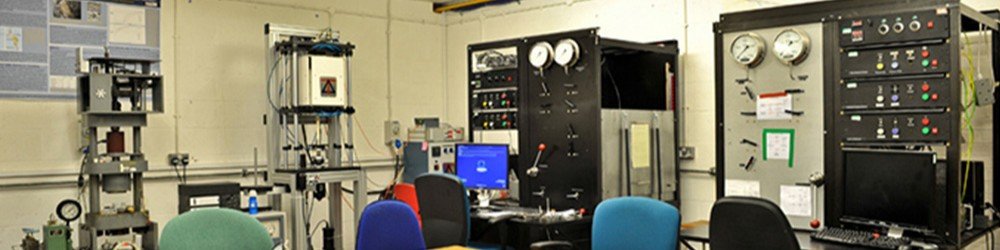
Rock Deformation Laboratory

Experimental facility with triaxial and rotary-shear apparatus operating to 200–250 MPa, largely designed and built in-house.

liverpool.ac.uk ↗
INGV HP-HT Laboratory

RESEARCH INSTITUTE · Rome, IT · 2015 — 2021

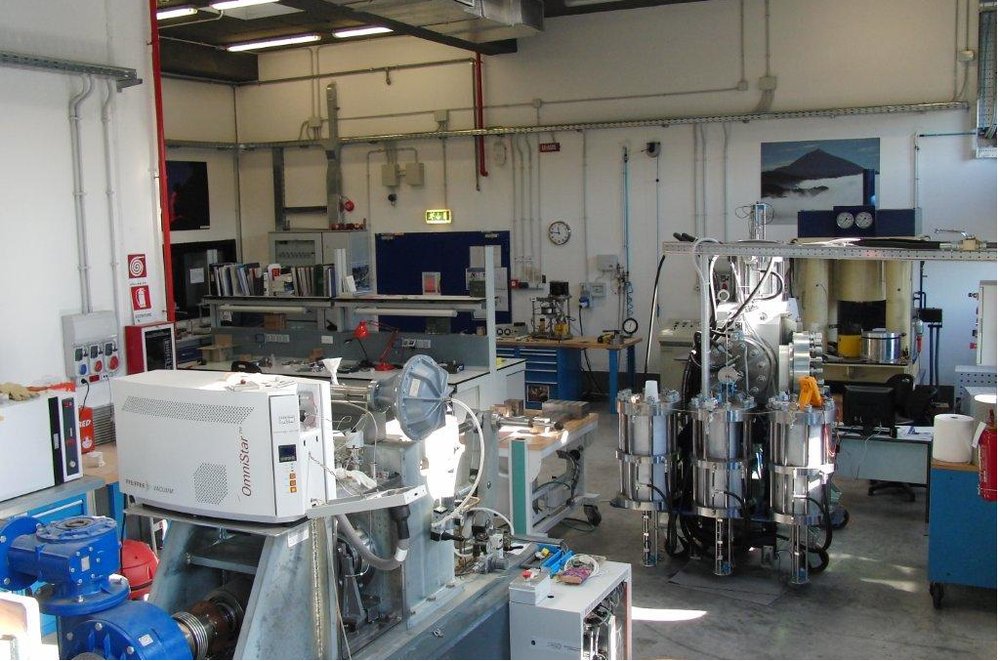
INGV HP-HT Laboratory

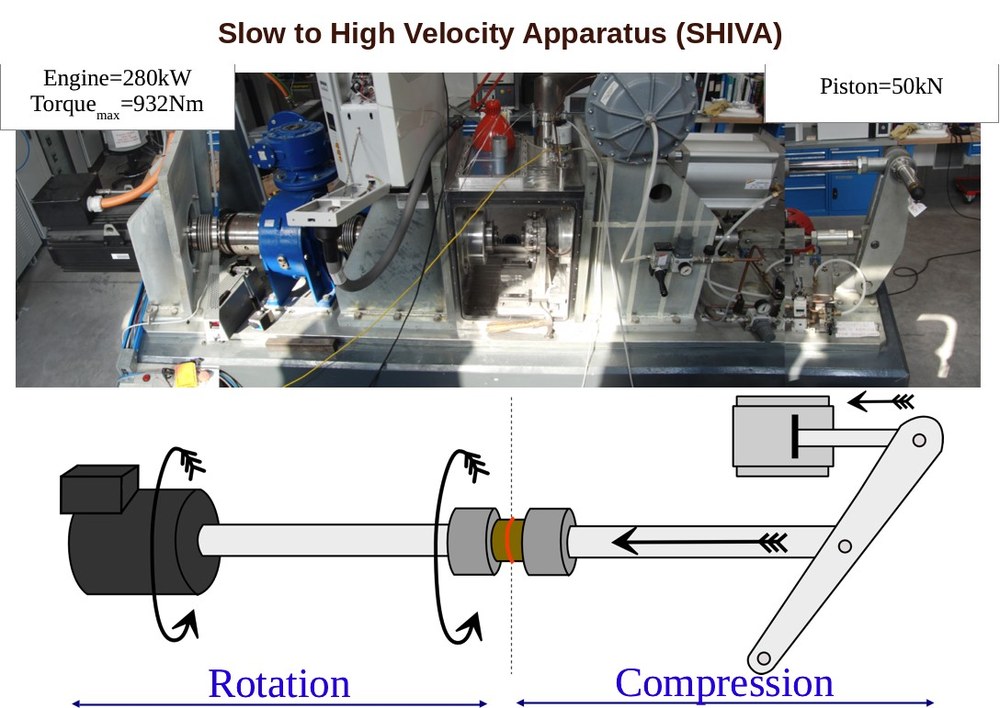
Multidisciplinary high pressure–high temperature facility with the SHIVA rotary-shear apparatus and microanalytics for rock and fault physics.

ingv.it ↗
Photo Archive

Conferences, places, and life along the way.

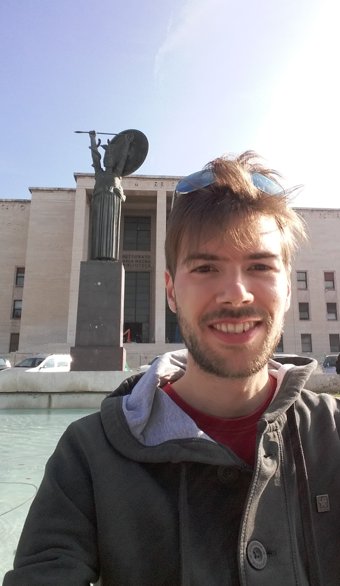
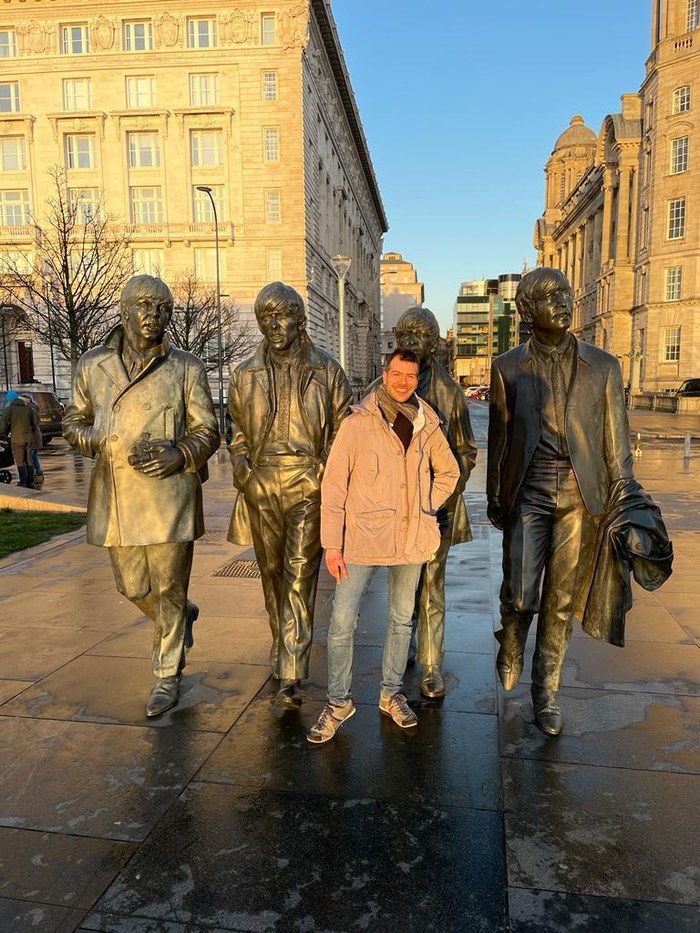
A few snapshots from conferences and from the cities this journey has passed through.

AI assistant

Explore my research & consultancy work.

A guided tour, not a generic chatbot: answers draw only on my CV, publications and public project documentation.

Stratos · Verified-source RAG assistantAI ASSISTANT
Hi, I’m Stratos, Piercarlo’s verified-source RAG assistant. Ask me about his work on carbon storage, geothermal systems, salt caverns, fault mechanics, or scientific software, or try one of the suggested questions.

Stratos currently answers verified factual questions in English.

Answers are generated from Piercarlo's own materials and may be imperfect; verify anything critical.